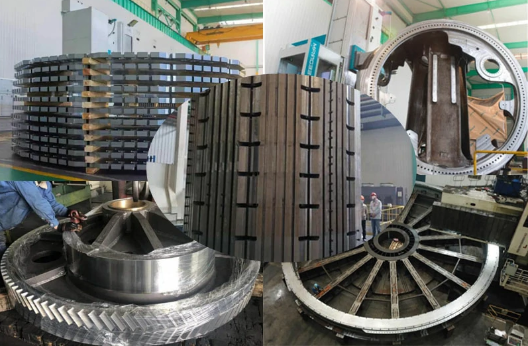
XIAMEN , FUJIAN, CHINA, November 3, 2026 /EINPresswire.com/ — What distinguishes a Global Leading Custom Metal Fabrication Company when industrial projects call for oversized structures, precision-machined parts, and coordinated production? The answer lies in the ability to combine engineering interpretation, heavy fabrication, machining, finishing, and inspection in a controlled workflow. Openex is a contract manufacturer focused on custom large-scale steel industrial equipment, weldments, machined components, and subassemblies. Its manufacturing model is designed to support original equipment manufacturers (OEMs) and engineering firms that need components made to project-specific drawings and specifications.
Mining systems, energy installations, processing plants, and infrastructure projects often require unusual dimensions, specialized materials, and components that must fit precisely with other assemblies. Buyers therefore need to assess production capacity, process coordination, technical experience, inspection methods, and delivery management alongside price.
Openex’s focus on large and complex industrial work positions its services around these practical requirements. Rather than concentrating on one type of finished product, the company combines multiple manufacturing disciplines to produce customized equipment and fabricated parts for different industrial sectors.
Integrated Fabrication and Machining Capabilities
A key part of Openex’s offering is the coordination of metal fabrication with large-scale CNC machining. The company undertakes cutting, welding, plate rolling, press braking, bending, hydraulic pressing, machining, thermal stress relieving, sandblasting, and painting. It can also assemble, test, package, and ship engineered products according to project specifications. Bringing these operations together can reduce the need for customers to coordinate several unrelated suppliers and helps maintain continuity between manufacturing stages.
Openex works with stainless steel, carbon steel, and aluminum in forms such as plate, sheet, bar, structural shapes, tubing, and pipe. Material selection depends on strength, corrosion exposure, fabrication method, and the final equipment’s requirements.
Its cutting capabilities include waterjet, laser, plasma, flame cutting, sawing, and robotic contour beveling. Different methods suit different material thicknesses, profiles, and edge requirements. After cutting, components may proceed to forming, rolling, bending, or welding. These operations are especially important for large structures, where sequence planning and dimensional control help manage distortion and ensure that parts can be assembled as intended.
Openex also provides large CNC turning and milling. These processes are used for components that require controlled dimensions, machined interfaces, or accurate alignment with adjoining parts. Combining fabrication and machining is particularly relevant for heavy equipment, where a welded structure may need precision-machined surfaces, bores, or mounting points before final assembly.
Products Designed for Industrial Applications
Openex’s product scope includes large pressure vessels, industrial heat exchangers, vacuum chambers, sterilization chambers, tube sheets, large flanges, reservoirs and storage tanks, industrial ductwork, engineered bases and frames, gearboxes and housings, heavy structural steel products, wind turbine components, truck dump bodies, and material-handling equipment.
Many of these products require coordinated forming, welding, and inspection. Tube sheets need accurately positioned holes for heat exchanger tubes, while large flanges and machined housings require precise interfaces. Machine bases and structural frames must provide suitable support and alignment for installed equipment.
The company’s services also cover custom sheet metal fabrication and large welded assemblies. This breadth allows Openex to work on individual components as well as more extensive fabricated subassemblies. For OEMs, this can help align component manufacture with the design and assembly requirements of the finished machine or industrial system.
Supporting Mining, Energy, Infrastructure, and Process Industries
In mining and construction, heavy frames, mill components, equipment housings, and material-handling products must withstand demanding operating conditions. Oil and gas projects use pressure-related equipment, tanks, flanges, and structural components, while power generation and renewable energy require large fabricated structures and machined parts.
Openex also identifies marine engineering, automotive, aerospace, defense, pulp and paper, and bridge construction among its application sectors. Each has its own design codes, material requirements, inspection expectations, and operating environments. A component intended for a marine installation, for instance, may face different exposure conditions from a machine frame used inside a factory. The manufacturing plan therefore needs to reflect the technical documentation and acceptance criteria for the specific project.
This cross-industry experience is relevant to customers whose products involve non-standard dimensions or several connected manufacturing processes. It also reflects a broader direction in industrial procurement: buyers increasingly value suppliers that can manage complex work packages instead of supplying only a single cutting, welding, or machining operation.
Project Examples and Manufacturing Problem-Solving
Openex’s case materials include the machining of vacuum chambers, mill cylinders for mining applications, water-treatment system components, large storage tanks, pedestrian bridge structures, and precision bridge U-ribs.
These projects illustrate different aspects of custom manufacturing. Vacuum chambers require coordinated forming, welding, and machining to achieve the intended shape and interfaces. Large mill cylinders call for suitable equipment and process planning to handle substantial workpieces. Storage tank and water-treatment projects involve the fabrication of components that must be integrated into larger industrial systems. Bridge U-ribs, meanwhile, demonstrate the importance of controlling forming operations when a component’s final geometry affects structural assembly.
Such projects depend on identifying manufacturing challenges early, selecting suitable processes, and checking that each stage supports the next. Drawing reviews, material choices, tolerances, welding requirements, and inspection plans all contribute to this process.
Quality Control and Coordinated Project Delivery
Quality assurance is central to heavy fabrication because defects or dimensional deviations can affect installation, performance, and service life. Openex describes a quality team and inspection capabilities that include coordinate measuring machine (CMM) inspection and radiographic non-destructive testing. These methods serve different purposes: CMM inspection checks dimensional characteristics, while radiography can help examine the internal condition of certain welds. The appropriate inspection scope depends on the product, specification, and applicable acceptance requirements.
The company lists ISO, CE, ASME, API, and LR certifications. The applicable certification, code, and inspection requirements should be confirmed for each product and project, particularly where compliance documentation is part of supplier qualification.
Openex’s contract manufacturing model also includes project management, assembly, testing, surface treatment, packaging, and shipping. With project managers, fitters, welders, machinists, and quality personnel involved in production, the company can coordinate work across disciplines. This is particularly useful when components are large, require multiple processes, or must arrive ready for a defined stage of equipment assembly.
Openex’s Role in the Evolving Metal Fabrication Sector
Industrial fabrication is shaped by demand for customized equipment, tighter dimensional requirements, consistent quality documentation, and efficient supply chains. CNC machinery, digital production planning, automated cutting, and inspection technology are changing production, while skilled personnel, sound process sequencing, material control, and engineering communication remain essential.
Openex brings these elements together through a manufacturing scope centered on large steel fabrication and precision machining. Its ability to work across cutting, forming, welding, machining, finishing, and inspection provides OEMs and engineering companies with a coordinated route from design documentation to completed industrial components.
As projects in mining, energy, infrastructure, and process manufacturing continue to require specialized metal products, suppliers with integrated capabilities will remain important to industrial production. Openex’s focus on custom large-scale equipment and fabricated assemblies reflects this need. More information about its manufacturing services, products, quality capabilities, and project examples is available at official website: https://www.cncmetalworking.com/.
Openex
Openex
Legal Disclaimer:
EIN Presswire provides this news content “as is” without warranty of any kind. We do not accept any responsibility or liability
for the accuracy, content, images, videos, licenses, completeness, legality, or reliability of the information contained in this
article. If you have any complaints or copyright issues related to this article, kindly contact the author above.

Media gallery