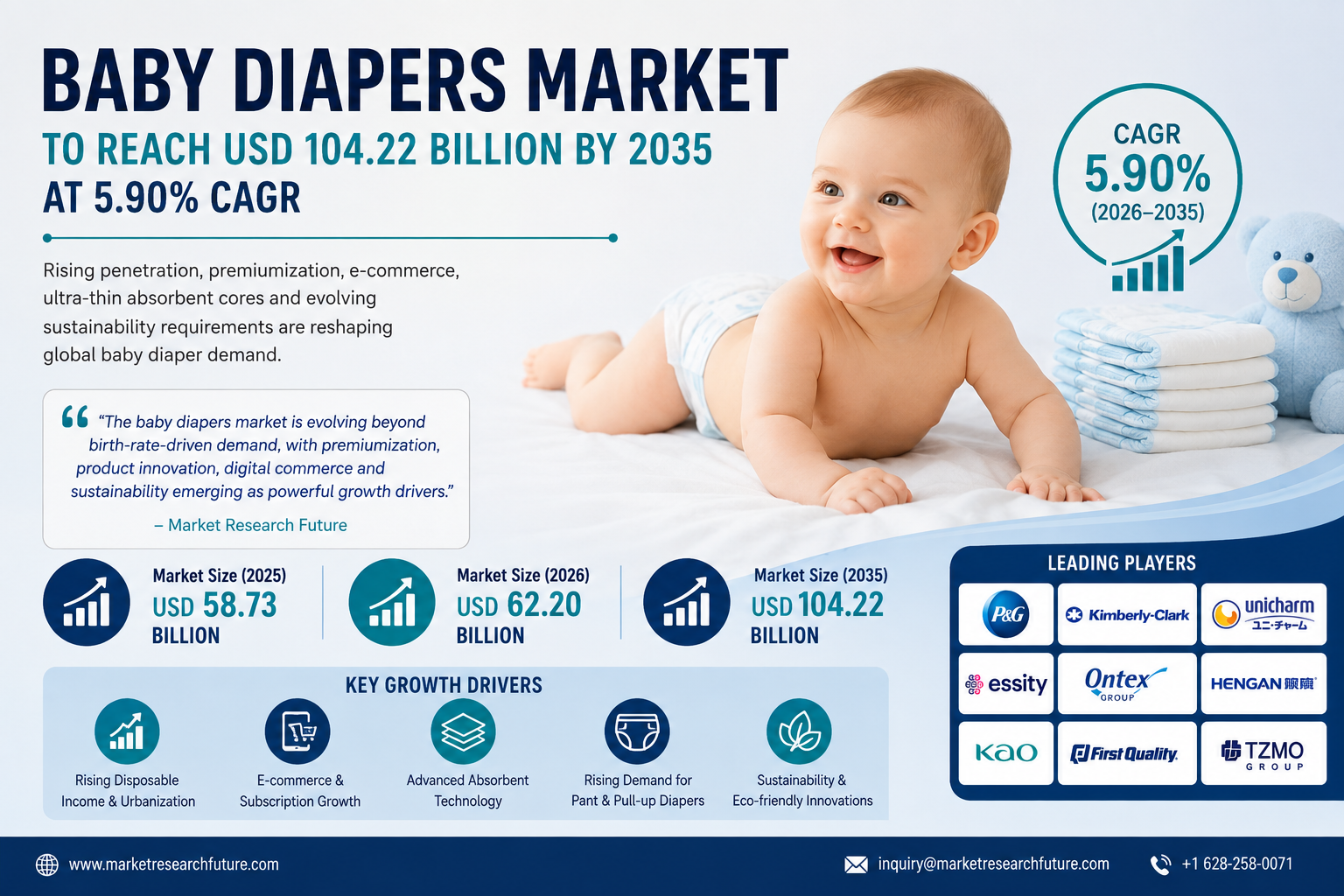
Rising penetration, premiumization, e-commerce, ultra-thin absorbent cores and evolving sustainability requirements are reshaping global baby diaper demand.
NEW YORK, NY, UNITED STATES, August 24, 2026 /EINPresswire.com/ — The global Baby Diapers Market is entering a new phase of growth as changing consumer purchasing patterns, rising disposable-hygiene penetration, product innovation and premiumization increasingly offset the impact of declining birth rates in several mature economies. According to Market Research Future, the market was valued at USD 58.73 billion in 2025 and is projected to increase from USD 62.20 billion in 2026 to USD 104.22 billion by 2035, registering a 5.90% CAGR during the 2026–2035 forecast period.
The market’s expansion is no longer simply a story about how many babies are born. Instead, value creation is increasingly being driven by how frequently disposable diapers are used, which product tiers parents choose, how rapidly emerging markets adopt organized hygiene products, and how manufacturers improve absorbency, thinness, comfort and sustainability.
Market Research Future’s analysis indicates that the Baby Diapers Market is being reshaped by several structural forces, including rising diaper penetration in emerging Asia and Africa, premium product migration in developed economies, digital replenishment and subscription purchasing, advances in superabsorbent polymer technology, urbanization and expanding organized retail networks. At the same time, declining fertility in China, Japan, South Korea and parts of Europe, raw-material price volatility, environmental regulation and private-label competition remain important challenges for manufacturers.
Baby Diapers Market Enters a New Growth Cycle
Baby diapers remain an essential consumer product category, but the economics of the industry are changing significantly.
In mature markets, manufacturers can no longer depend primarily on unit-volume expansion. Instead, brands are increasingly generating revenue through premium product tiers featuring enhanced softness, sensitive-skin positioning, wetness indicators, extended-wear performance, improved fit and specialized newborn designs.
In emerging markets, meanwhile, the primary opportunity remains penetration. A large proportion of annual births occur in countries where disposable-hygiene adoption remains substantially below developed-market levels. As household incomes increase, women participate more actively in the workforce, urban populations expand and organized retail becomes more accessible, disposable diapers are moving from an occasional convenience to an everyday household necessity.
The combination creates two distinct growth engines: premiumization in mature markets and penetration-led volume growth in emerging markets.
This divergence is particularly important for manufacturers and investors because it means the global market can continue expanding even when demographic trends are unfavorable in several major economies.
Get Full PDF Sample Copy of Report: (Including Full TOC, List of Tables & Figures, Chart) @ https://www.marketresearchfuture.com/sample_request/6667
Disposable Diapers Continue to Dominate
Disposable diapers account for approximately 78% of Baby Diapers Market value, supported by convenience, hygiene and the time-saving requirements of modern households.
For dual-income families and urban consumers, the labor associated with washing and maintaining reusable diapers remains an important factor influencing purchasing decisions. Disposable products provide predictable absorbency, convenience and easy disposal, making them the preferred solution for a broad share of parents.
Cloth diapers continue to serve a more specialized consumer base. The segment is projected to grow at approximately 3.4% CAGR, supported by sustainability-focused households and consumers emphasizing cost per use.
At the same time, biodegradable and hybrid constructions are emerging as an important growth category. These products reached approximately USD 4.62 billion in 2025, reflecting increasing interest in lower-impact materials and changing retailer and regulatory expectations.
The resulting market is therefore becoming more segmented, with conventional disposable products maintaining scale while sustainable alternatives compete for higher-value consumers.
Ultra-Thin Absorbent Technology Becomes a Strategic Differentiator
Product architecture is undergoing a major transformation.
Traditional diaper constructions that relied heavily on thick fluff pulp are increasingly being replaced or supplemented by advanced superabsorbent polymer (SAP) cores. These technologies allow manufacturers to create thinner products while maintaining or improving fluid retention.
Advanced ultra-thin SAP cores are projected to expand at approximately 7.9% CAGR, making the technology one of the industry’s most important areas of product development.
The benefits extend beyond consumer comfort. Thinner products can reduce material requirements, increase the number of units that fit into a shipping case and improve pallet utilization. These changes can lower logistics costs and potentially strengthen converter margins.
For manufacturers, absorbency technology is therefore becoming both a product-quality issue and a supply-chain optimization opportunity.
Companies that can deliver thinner products without compromising leakage protection, softness or skin comfort are positioned to compete more effectively across both premium and value segments.
Premiumization Changes the Economics of Mature Markets
The demographic ceiling is becoming increasingly visible across several developed markets.
China, Japan, South Korea and many European countries are experiencing low fertility rates and declining birth cohorts. This creates structural pressure on absolute diaper volumes.
However, declining volume does not necessarily translate into declining market value.
Parents in mature economies are increasingly willing to pay more for products offering improved fit, sensitive-skin features, longer wear, better absorbency and specialized performance. Manufacturers are responding by creating multiple pricing tiers within individual brands.
This shift from volume growth to value growth is particularly relevant in North America, where the market is projected to expand at approximately 6.8% CAGR during the forecast period.
Premium tiers, direct-to-consumer replenishment, sensitive-skin claims and subscription purchasing are helping manufacturers increase realized revenue per diaper even where birth volumes remain relatively flat.
The result is a market in which consumer mix can be as important as demographic growth.
E-Commerce and Subscription Replenishment Reshape Distribution
Digital commerce is rapidly becoming a core distribution channel for baby diapers.
Nearly 25% of global category sales are estimated to occur online, with online penetration particularly high in China. E-commerce enables parents to purchase diapers in larger quantities, compare brands more easily and establish recurring replenishment schedules.
Subscription models are particularly attractive because diaper consumption is relatively predictable during a child’s development stages. Once a household selects a preferred brand, automated replenishment can reduce the likelihood of switching while creating a recurring relationship between manufacturer, retailer and consumer.
For manufacturers, direct and digital channels can also provide access to valuable purchasing data. Information about preferred sizes, product formats, reorder frequency and price sensitivity can help companies optimize inventory, promotions and product development.
Online retail is therefore moving beyond being simply another sales channel. It is increasingly becoming a strategic mechanism for customer retention, demand forecasting and brand differentiation.
Pant and Pull-Up Formats Gain Momentum
Although taped diapers continue to represent approximately 58% of market value, pant and pull-up formats are growing rapidly.
The transition is closely linked to child development. As babies begin crawling, walking and becoming more mobile, parents often prioritize speed and convenience during diaper changes.
Pant-style products address this need by making application easier, particularly for active toddlers.
The segment is projected to grow at approximately 7.6% CAGR, creating an important mix-upgrade opportunity for manufacturers.
India and Indonesia are among the markets where pant-format adoption is developing rapidly. As consumers become more familiar with premium pull-up products, manufacturers can potentially increase average selling prices while simultaneously improving convenience.
This makes pant formats strategically significant not only because of their volume growth but also because they can contribute to premiumization.
Asia-Pacific Remains the Largest Regional Market
Asia-Pacific represents approximately 42% of global Baby Diapers Market value, with China, India, Japan and ASEAN markets contributing substantially to the regional opportunity.
The region is highly diverse.
China is increasingly characterized by value defense, online-first purchasing and competition from domestic brands amid declining birth rates. Japan represents a technology and premiumization benchmark, with highly developed diaper engineering and recycling initiatives.
India presents a very different opportunity. Rising urbanization, expanding organized retail, increasing disposable-hygiene penetration and rapid adoption of pant formats are supporting market growth. The India segment is projected to grow at approximately 9.1% CAGR, making it one of the most attractive country-level opportunities identified in the market outlook.
ASEAN markets are also benefiting from rising middle-class household formation and increasing access to organized retail and e-commerce.
This regional diversity means companies cannot apply a single strategy across Asia-Pacific. Mature markets require innovation, premiumization and value defense, while emerging markets require affordability, distribution expansion and localized product formats.
North America Focuses on Value and Premium Mix
North America is expected to be the fastest-growing regional market by CAGR, at approximately 6.8% through 2035.
The region’s growth is being supported less by rising birth volumes and more by changes in consumer mix.
Premium diapers, sensitive-skin positioning, wetness indicators, extended-wear products and subscription replenishment are helping brands capture higher value from existing households.
Private-label products are also strengthening their position as retailers seek competitive pricing and stronger customer loyalty.
The United States represents the majority of regional value, while Mexico provides an important volume-growth opportunity as organized grocery and modern retail penetration increases.
Europe Prioritizes Sustainability and Compliance
Europe represents approximately 22% of global Baby Diapers Market value, but the region’s growth trajectory is strongly influenced by environmental and packaging regulation.
Manufacturers face increasing pressure to reduce virgin plastic use, improve material transparency and address end-of-life considerations.
These regulatory developments are encouraging investment in bio-based backsheets, alternative nonwoven materials, reduced-plastic designs and recycling initiatives.
The compliance burden can create challenges for smaller converters, but it also favors manufacturers with the scale and technical resources needed to redesign products and meet evolving requirements.
Private-label penetration is another important feature of the European market, increasing competition on price while encouraging manufacturers to improve production efficiency.
Middle East & Africa Offer Significant Penetration Headroom
The Middle East and Africa represent approximately 8% of global market value, but the region has some of the strongest long-term penetration opportunities.
Gulf markets are increasingly characterized by modern retail, premium products and e-commerce. By contrast, several Sub-Saharan African markets remain significantly underpenetrated.
Affordability is a central issue.
Smaller pack sizes, sachet distribution, local converting capacity and pharmacy-led sales can make disposable diapers more accessible to lower-income consumers. Local manufacturing can also reduce transportation and landed costs.
As organized retail expands across Africa, manufacturers that can combine affordable pricing with reliable distribution are positioned to capture incremental demand.
Sustainability Becomes a Competitive Requirement
Environmental considerations are becoming increasingly important across the Baby Diapers Market.
Manufacturers are exploring bio-based polyethylene backsheets, alternative nonwoven materials, bamboo and bagasse-derived fibers, improved material efficiency and recycling technologies.
However, sustainability remains closely linked to economics. Fully compostable or bio-based absorbent cores are still more expensive than conventional alternatives, meaning cost parity remains a longer-term challenge.
The market is therefore likely to evolve incrementally rather than through a single disruptive transition.
Manufacturers are expected to focus on reducing material intensity, increasing recycled or renewable content where technically feasible and improving end-of-life options while maintaining the performance and affordability consumers expect.
Competitive Landscape
The global Baby Diapers Market is moderately concentrated, with leading multinational manufacturers competing alongside regional specialists, private-label producers and emerging digital-native brands.
Major companies identified in the market landscape include Procter & Gamble, Kimberly-Clark, Unicharm, Essity, Ontex Group, Hengan International, Kao Corporation, Daio Paper, First Quality Enterprises, Hayat Kimya, Nobel Hygiene and TZMO Group.
Competition is increasingly based on a combination of brand strength, manufacturing efficiency, absorbency technology, sustainability credentials, retail relationships and digital distribution.
Multinational companies continue to leverage global scale and research capabilities, while regional brands are using local consumer insights, lower cost structures and e-commerce models to gain market share.
The competitive environment is also encouraging portfolio specialization. Companies are increasingly deciding where to invest in premium innovation, where to compete on affordability and where to use private-label manufacturing to maximize production capacity.
Emerging Opportunities Across the Value Chain
Several opportunities could shape the next decade of the Baby Diapers Market.
Advanced absorbent materials can improve performance while reducing product thickness and logistics costs.
Pant and pull-up formats offer manufacturers an opportunity to increase value per unit as toddlers become more mobile.
Online subscriptions can strengthen customer retention and create predictable recurring demand.
Private-label manufacturing provides converters with opportunities to increase capacity utilization without bearing the full cost of brand development.
Local production in emerging markets can improve affordability and reduce dependence on imported finished products.
Circularity and recycling technologies could eventually convert used absorbent products into recoverable raw materials, helping manufacturers respond to extended producer responsibility requirements.
Connected technologies may also create new possibilities. Wetness sensors, RFID-enabled products and data-driven monitoring systems could eventually extend the category beyond conventional absorbent products toward connected childcare and care-management solutions.
Future Outlook
The Baby Diapers Market is projected to grow from USD 58.73 billion in 2025 to USD 104.22 billion by 2035, reflecting a 5.90% CAGR over the 2026–2035 forecast period.
The central theme of the next decade will be value creation beyond birth rates.
In mature economies, manufacturers will increasingly depend on premiumization, product innovation and higher realized prices. In emerging economies, penetration, affordability and distribution expansion will remain the principal growth levers.
Technology will influence both sides of the equation. Advanced SAP cores can reduce material use and improve logistics economics, while e-commerce and subscription models can strengthen consumer relationships. Meanwhile, sustainability requirements will continue to reshape product design and manufacturing decisions.
The companies best positioned for the next phase of market development will be those capable of balancing three priorities: performance, affordability and sustainability.
As the category moves toward 2035, the competitive advantage will increasingly belong to manufacturers that can deliver thinner and more efficient products, respond quickly to changing consumer preferences, build strong digital relationships and adapt product architecture to evolving environmental requirements.
The Baby Diapers Market is therefore not simply expanding because more diapers are being purchased. It is evolving because the definition of value in the category is changing — from basic absorbency toward convenience, performance, personalization, digital replenishment, sustainability and smarter manufacturing.
Discover Related Research Reports By Market Research Future:
Biodegradable Baby Diapers Market
https://www.marketresearchfuture.com/reports/biodegradable-baby-diapers-market-25587
Baby Crib Market
https://www.marketresearchfuture.com/reports/baby-crib-market-25606
Baby Wipes Market
https://www.marketresearchfuture.com/reports/baby-wipes-market-7298
Market Research Future
Market Research Future
+1 855-661-4441
email us here
Legal Disclaimer:
EIN Presswire provides this news content “as is” without warranty of any kind. We do not accept any responsibility or liability
for the accuracy, content, images, videos, licenses, completeness, legality, or reliability of the information contained in this
article. If you have any complaints or copyright issues related to this article, kindly contact the author above.

Media gallery