
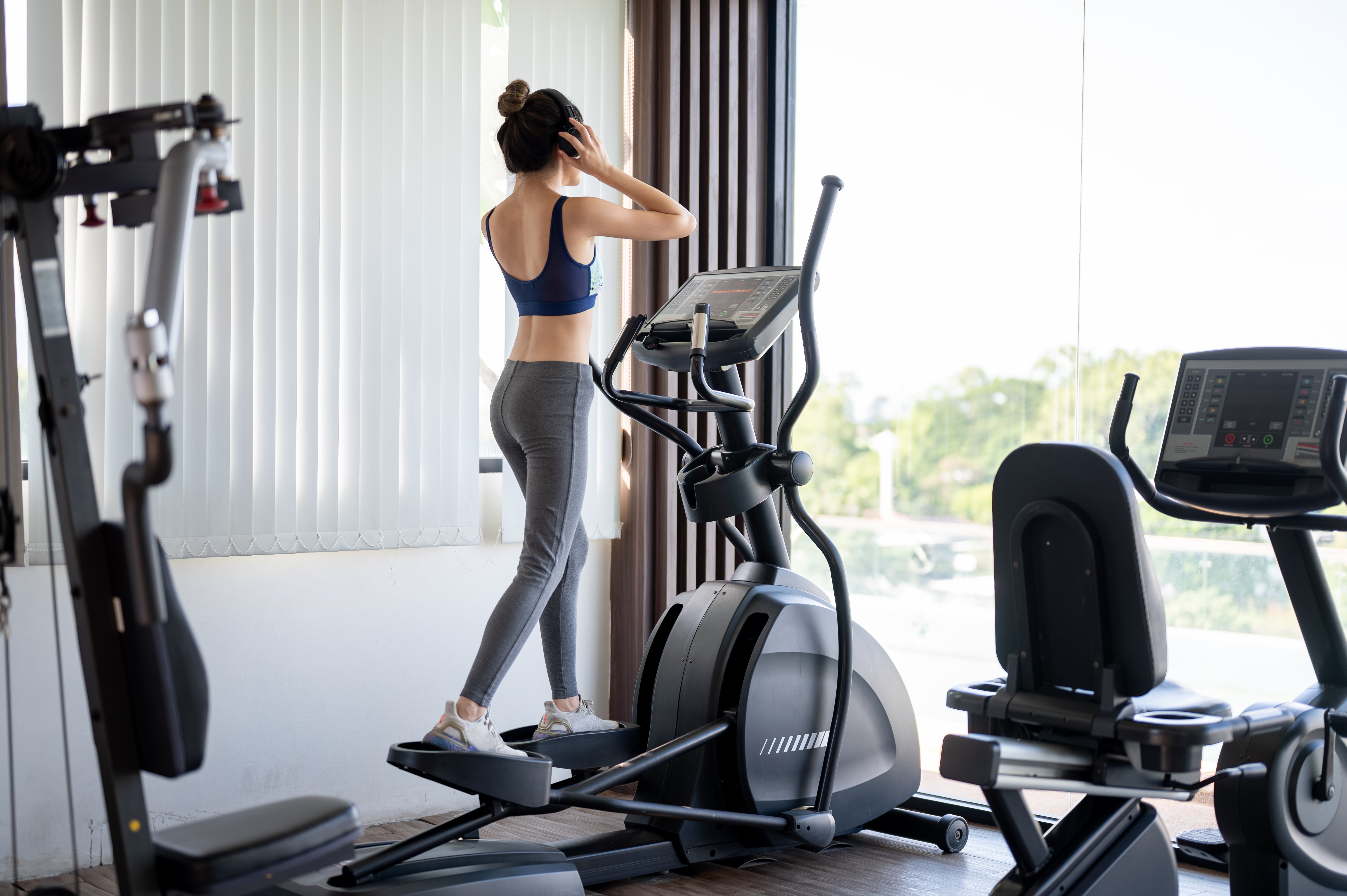
Key Takeaways:
- Ellipticals can engage up to 80% of the body’s muscles simultaneously – something no other single cardio machine comes close to matching.
- Most home cardio equipment (treadmills, stationary bikes) is predominantly leg-driven; ellipticals are the rare exception that meaningfully loads the upper body too.
- Low-impact training on an elliptical protects joints from repetitive impact stress, and at higher resistance levels and equivalent effort, calorie burn can be comparable to running.
- Getting a true full-body workout on an elliptical comes down to technique: passive handle use turns a total-body machine into an expensive leg press.
Ellipticals Work 80% of Your Muscles – Simultaneously
Fitness experts keep returning to ellipticals for a reason: with proper form and active handle engagement, they work roughly 80% of the body’s muscles in a single session, combining cardiovascular training with meaningful resistance across both the upper and lower body. That’s a functional reality rooted in the machine’s design, not a marketing claim.
The motion itself is the advantage. Each stride coordinates leg drive with arm push-pull, engaging the chest, back, shoulders, arms, glutes, hamstrings, quads, calves, and core in concert. The result is a workout density that most single pieces of cardio equipment simply can’t replicate at home.
Why Other Home Cardio Falls Short
Treadmills and Bikes: Mostly Leg Work
Treadmills are effective, but honest about their scope: they train the legs and cardiovascular system, with the core doing stabilization work and the arms largely along for the ride. Stationary bikes are even more focused – the legs drive the movement, the upper body is essentially a passenger. Both are valuable tools, but neither delivers broad muscular engagement in a single session.
A study comparing muscle activation found elliptical training produced greater quadriceps activity and greater quadriceps-to-hamstrings co-activation than stationary cycling, treadmill walking, and even overground walking. That’s just the lower body comparison – before upper body engagement is factored in at all.
What True Full-Body Engagement Requires
Genuine full-body cardio requires a machine that loads the upper body with real resistance – not token arm motion. The handles have to move against meaningful pushback, and the user has to consciously drive them. When both conditions are met, an elliptical becomes something categorically different from other home cardio options.
The Muscles an Elliptical Actually Trains
Upper Body: Active Handle Use Engages Chest, Shoulders, Arms, and Back
The push phase of the handle motion activates the chest, shoulders, and triceps. The pull phase loads the lats, rhomboids, traps, and biceps. The key word in both cases is active – mindfully driving the handles rather than resting hands on them. When that intention is present, the upper body contribution to the workout becomes tangible and measurable.
Lower Body: Quads, Glutes, Hamstrings, and Calves
The elliptical’s lower body engagement is both broad and adjustable. At standard incline, the quads and calves carry most of the load. Increase the incline and the emphasis shifts toward the glutes and hamstrings. Pedaling in reverse challenges the quadriceps differently and introduces a balance demand that forward-only training doesn’t create. This means virtually every major lower-body muscle group can be targeted within a single session simply by varying incline and direction.
Core: Continuously Stabilizing Every Stride
Maintaining upright posture on an elliptical requires the abdominals and lower back to work continuously throughout the session. This sustained stabilization is integrated into cardio, building functional core endurance rather than isolated strength.
Low-Impact Training, High-Intensity Results
Joint-Safe Cardio Comparable to Running
Running generates repeated impact forces through the knees, hips, and spine. The elliptical eliminates that jarring contact entirely – the feet never leave the pedals. While treadmill running generally burns slightly more calories, research shows the calorie burn on an elliptical can be comparable at higher resistance levels and equivalent effort. For anyone managing joint sensitivity, recovering from injury, or protecting long-term joint health, this is a meaningful distinction.
Elliptical cross-trainer use, often combined with physiotherapy, is recognized for its joint-friendly motion and can lead to measurable health improvements for individuals recovering from injuries or managing joint sensitivity. Cardiovascular intensity is fully controllable through resistance and incline, making everything from steady-state aerobic work to high-intensity interval training (HIIT) accessible – without the impact cost.
Weight-Bearing Benefits for Bone Strength
Unlike swimming or cycling, elliptical training is weight-bearing. The body supports its own load throughout the workout, which plays a role in maintaining and building bone density over time – an often-overlooked benefit for long-term health, particularly for osteoporosis prevention. Research also supports that regular elliptical training measurably improves VO2 max and cardiovascular endurance, placing it firmly in the category of serious fitness tools rather than gentle rehabilitation equipment.
5 Techniques to Maximize Full-Body Results
The elliptical’s potential is only realized through intentional use. These five techniques convert a standard cardio session into a genuinely full-body workout.
1. Actively Drive the Handles
This is the single most important habit to develop. Resting hands on moving handles produces almost no upper-body benefit. The chest should feel a contraction during the push; the back should feel engagement during the pull. If neither is happening, the grip is passive – increase the intention, not just the resistance.
2. Vary Your Grip Position
Machines with multiple handle grip positions allow targeted shifts in upper-body emphasis. A higher grip recruits more shoulder and upper-back involvement. A lower grip moves the load toward the chest and triceps. Cycling through positions within a single session produces more complete upper-body development than staying locked into one placement.
3. Use Incline Strategically
Higher incline settings intensify glute and hamstring activation significantly, while lower incline settings can shift emphasis toward the hamstrings and calves. Varying incline throughout a session – rather than setting it once and leaving it – is the most efficient way to develop balanced lower-body strength while maintaining consistent upper-body loading through the handles.
4. Incorporate Reverse Intervals
Pedaling in reverse changes which muscles do the primary work and introduces a new balance challenge that the core must respond to. Adding 2-3 minute reverse intervals every 10 minutes builds training variety and strengthens movement patterns that forward-only training leaves underdeveloped.
5. Maintain Upright Posture Throughout
Fatigue naturally pulls the torso forward and onto the handles. Resisting that urge keeps the core actively engaged and ensures the arms are driving – not just supporting body weight. If maintaining upright posture becomes difficult, reduce resistance rather than compromising form.
The Right Elliptical Turns Every Cardio Session Into a Full-Body Workout
Not every elliptical delivers on the full-body promise. Machines with lightweight flywheels create choppy, inconsistent motion that breaks muscular engagement at the transition points. Handles without real resistance become decorative. The equipment itself matters as much as the technique applied to it.
What separates a genuine full-body elliptical from a glorified leg machine comes down to a few design requirements: moving handles with meaningful resistance, a heavy enough flywheel for smooth momentum, adjustable incline, and forward/reverse pedaling capability. When those elements are present, every cardio session becomes a full training stimulus – upper body, lower body, and core, simultaneously, with zero joint impact.
For home fitness enthusiasts who want cardio that does more without demanding more time, the elliptical stands as the most efficient choice available for complete, low-impact, full-body conditioning under one roof.
SOLE Fitness
56 Exchange Pl.
Salt Lake City
UT
84111
United States


